Monday, August 10, 2009

Spreading Lionfish Invasion Threatens Bahamas

The spiny, venomous lionfish. Michael Dwyer/AP

The spiny, venomous lionfish can kill three-quarters of a reef's fish population in just five weeks, according to one study. Michael Dwyer/AP

The spiny, venomous lionfish. Michael Dwyer/AP

The spiny, venomous lionfish can kill three-quarters of a reef's fish population in just five weeks, according to one study.Michael Dwyer/AP

In 1992, Hurricane Andrew smashed an aquarium tank in Florida. About a half-dozen spiny, venomous lionfish washed into the Atlantic Ocean, spawning an invasion that could kill off local industry along with the native fish.

People come to the Exuma Islands in the Bahamas to kayak between tiny, uninhabited islands and dive in the shallow, turquoise water. Above the water, the landscape looks like a pristine tropical paradise. But the same isn't true beneath the waves.

"In 2005, the first lionfish showed up, and we didn't pay much attention to it," says Oregon State University zoology professor Mark Hixon, who has studied reef fish here for almost two decades. "The next year, we saw a few more. Then in 2007 there was a population explosion. There were so many lionfish around that they were eating the fish we were studying, and we had to start studying the lionfish. There was nothing else to do."

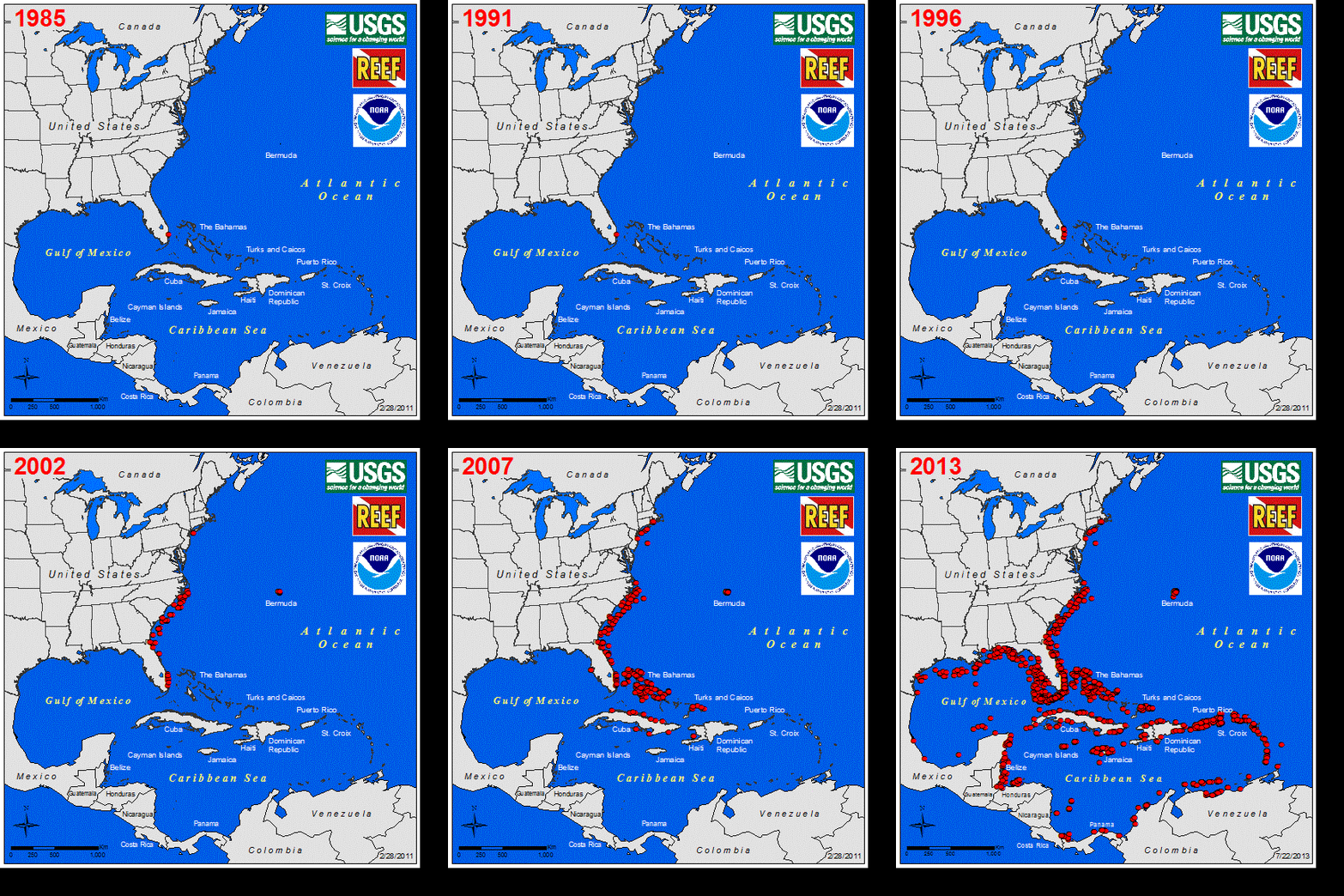
Lionfish are native to the Indian and Pacific oceans. But in the past few years, they've spread up the Eastern seaboard and throughout the Caribbean. The Bahamas have been hit the hardest.

At NOAA.gov

"This year we're going to see if that's gotten worse — because the number of lionfish has definitely increased in the intervening year," Hixon says.

What Stops A Lionfish?

Diving around a coral reef, Hixon shines a light under every ledge, looking for lionfish and the fish they like to eat. After a few minutes, he waves his light frantically under an overhang. A lionfish the size of a football fans the water with its huge, quilled fins. These days, the only thing unusual about spotting a lionfish in the Bahamas is seeing just one of them.

Back on the boat, Hixon is upbeat. Last year his team pulled more than a dozen lionfish off this reef. "And this year, there's just one," he says. "What that tells us is that our removals took, and lasted a whole year."

But Hixon says divers can only catch so many. So he's also studying native lionfish in the Pacific Ocean to understand what keeps their populations in check.

Parasites could be one limiting factor. Zoologist Paul Sikkel peers through a microscope at the gills of one of the lionfish Hixon's team has just caught.

"Wow! Just so clean," Sikkel exclaims. "There's nothing in there. Have a look. A local fish, you'd see a bunch of really small worms on those red gill filaments. And they squirm, so it's easy to pick them out. But there's nothing on there."

The parasites that would be swarming over a local fish aren't going near the lionfish. Sikkel says that might be one secret to the invasion.

"If you consider parasites a sort of a tax that fish have to pay, a lot of their energy gets diverted into parasites, and so a fish that doesn't have those [parasites] can develop more of its energy into its own growth and reproduction," Sikkel says.

Tourism, Fishing Fall Prey

Until marine predators or parasites learn to feed on lionfish, the best hope for slowing the spread may be humans. The fish are a delicacy in Asia, but not in the Bahamas, given the painful sting their spines can inflict. A few restaurants serve lionfish now, and there's an effort to teach Bahamians how to catch and cook them.

Lakeshia Anderson with the Bahamas Department of Fisheries says the livelihoods of many islanders depend on slowing the invasion.

"With the quantities of lionfish that we've found in our waters and the amount of food they consume, it has the potential of really collapsing our commercially important species — our fishing industry in general," Anderson says.

But that's not all. Tourism is a $5 billion-a-year industry and accounts for half the employment in the Bahamas. Anderson worries that if the lionfish continue to devour colorful reef fish, divers will vacation elsewhere.

Hixon says in some places, the damage is already done.

"I was diving on a reef I've studied since 1991," he recounts. "It was so degraded, and there were so few fish in what used to be a teeming reef, that at one point I was overcome and went to tears."

He says in the best case scenario, some natural control will kick in and lionfish will become a minor part of the Caribbean and Atlantic reef community.

Flying frog among 353 new Himalayan species: WWF

A flying frog, the world's smallest deer and the first new monkey to be found in over a century are among 350 new species discovered in the eastern Himalayas in the past decade, the WWF said Monday.

But the environmental group said the vital habitats of the mountain range were facing growing pressures from unsustainable development in the region, which spans Nepal, China, India, Bhutan and Myanmar.

In a report released here, it said climate change, deforestation, overgrazing by domestic livestock and illegal poaching and wildlife trading threatened one of the biologically richest areas of the planet.

"In the last half-century, this area of South Asia has faced a wave of pressures as a result of population growth and the increasing demand for commodities," said the report, "The Eastern Himalayas -- Where Worlds Collide."

"Only 25 percent of the original habitats in the region remain intact. For the unique species of the Eastern Himalayas, this means that today 163 are considered globally threatened," it said.

The WWF said 353 new species were discovered in the region between 1998 and 2008, among them a red-footed tree frog known as a "flying frog" because its large webbed feet allow it to glide when falling.

Another new species was a kind of caecilian, a limbless amphibian that resembles a giant earthworm and lives underground -- a significant discovery because caecilians are among the planet's least-studied creatures.

Other highlights were the world's smallest deer -- a miniature muntjac standing just 60-80 centimetres (25-30 inches) tall that was found in northern Myanmar -- and the first new monkey species to be discovered in over a century.

The WWF said the new species of macaque was one of the highest-dwelling monkeys in the world, living in India's Arunachal Pradesh state at between 1,600 and 3,500 metres (5,000 and 11,500 feet) above sea level.

Among the 242 new plant varieties discovered was an ultramarine blue flower found by two intrepid Chinese botanists who descended into a gorge in Tibet that is twice as deep as the Grand Canyon in places.

The WWF described the rare bloom as "dramatic in both colour and form" and said its colour changed with the temperature, making it particularly remarkable.

The eastern Himalayas is home to 10,000 plant species, 300 mammal species and nearly 1,000 bird species, and is the last place on earth where the greater one-horned rhino can still be found.

"This enormous cultural and biological diversity underscores the fragile nature of an environment which risks being lost forever unless the impacts of climate change are reversed," said Tariq Aziz, leader of the WWF's Living Himalayas initiative.

The report's findings come as world leaders prepare to gather in Copenhagen in December to reach agreement on a new climate deal to replace the Kyoto Protocol.


Flying frog among 353 new Himalayan species: WWF

Food crisis could force wartime rations and vegetarian diet on Britons


A farmer combining


The British people face wartime rations and a vegetarian diet in the event of a world food shortage, a new official assessment on the UK’s food security suggests today.

Even though the nation is 73 per cent self-sufficient in food production, higher than during the 1950s, the food chain is at risk from global influences such as a worldwide increase in population, climate change bringing extreme weather patterns, higher oil prices and more crops being grown for bio-fuel instead of food.

Supplies in future may also be disrupted by animal disease outbreaks, disruption of power supplies, trade disputes and interruptions for shipping and at ports.

The UK however has one of the highest cereal production capabilities in the world with seven tonnes grown per hectare, compared a world average of 3.3 tonnes per hectare.


In the event of an extreme event, cereal crops would be used to feed the nation and ensure that each person received sufficient daily calories.

But people would have to consume less — the average number of calories eaten per day in the early 1960s was about 2,100, whereas the most recent figure compiled by the United Nations Food and Agriculture Organisation is 2,800.

Even during the Second World War Britain did not have to rely wholly on domestic food production, but Hilary Benn, the Cabinet Minister with overall responsibility for food policy, has ordered officials to prepare for a scenario where the country could feed itself.

In the event of an extreme emergency the most dramatic consequence would be every person eating a predominantly vegetarian diet — more cereals, fruit and vegetables and less meat and poultry. Cereals used to feed farm animals would be shifted into human food production.

A paper setting out the food security assessment states that the food on offer would be “a highly restricted, if sufficiently nutritious diet”.

One of the biggest threats to the supply chain would be restrictions in trade of meat and poultry from Argentina and Brazil or of GM soya, the main commodity used to feed livestock in Britain.

The threat of climate change however will also require new growing techniques such as reduced water usage in agriculture.

In times of normal trading, however, the Government also wishes to ensure that the nation eats a healthier diet and is particularly concerned that low-income households are able to afford fresh fruit and vegetables.

Ministers are also anxious that consumers have confidence in the safety of food and further work is to be undertaken to help reduce the incidence of food poisoning caused by common bugs such as salmonellas, listeria, E.coli and campylobacter. Hygiene inspections at food outlets by local authority enforcement officers is likely to be stepped up.

Mr Benn today called for a radical rethink on the way the UK produces food. He also insisted that GM crops in future could help boost food production especially if some varieties were drought-resistant or required less water, fertilisers and pesticides.

He backed the need for GM crop trials to find out the facts about the new technology and to use the science to boost production.

“We need a radical rethink in how we produce and consume food. Globally we need to cut emissions and adapt to the changing climate that will alter what we can grow and where we can grow it. We must maintain the natural resources — soils, water and biodiversity — on which food production depends.”

“And because we live in an interconnected world — where the price of soya in Brazil affects the price of steak at the local supermarket — we need to look at global issues that affect food security here. That’s why we need to consider what food systems should look like in 20 years and what must happen to get there.”

He is anxious to engage the wider public in debate about the future of the country’s food security as well as how best to help people eat healthier diets and to ensure that new production techniques do not damage the UK’s natural resources.

A new UK food strategy is to be published before the end of the year.

Sunday, August 9, 2009

Boulder & 'Julia': Can Boulder channel its inner Julia Child -- while being locavore and vegan?

When Julie Powell decided to cook her way through Julia Child's "Mastering the Art of French Cooking," she found her passion and changed her life.

How would Boulder's notoriously particular eaters -- many of whom view food through a environmental, health and political lens -- interpret one of Child's classic recipes, the bacon, cream and egg tart, Quiche Lorraine?

At Culinary School of the Rockies, appreciation for Julia Child's role in modern American cooking is a given. Office staffers are trying out Child's recipes and blogging about them a la Julie, and the school is offering a home cooking class -- nearly full at the time of this writing -- on Aug. 15 called "Brunch and Julia."

Chef Adam Dulye says American cooks have come back to essence of Child's approach -- sourcing impeccably fresh local ingredients and combining them in straightforward, flavorful ways.

"I think it's definitely back to simple is the way to go," he says. "Only three or four items on a plate. This is a pork chop (that) tastes like a pork chop."

Not the multi-ingredient, layers of exotic ingredients that were popular in the 1980s and 1990s.

Of Child's cooking, he says: "It's going to the market and cooking it. In Boulder, we have a great opportunity to do (Quiche Lorraine) from the ground up. There are people who mill flour, fresh eggs, a couple of dairies, John Long pork. Haystack puts out a firm goat cheese. Dulye might throw in a few of the last spring onions.

While Quiche Lorraine is likely to please locavores, for vegans it's pretty tough sledding. Matt Burns sous chef at Leaf Vegetarian Restaurant says the staff does make eggless egg dishes, but that quiche would be particularly challenging.

He says a custard might be approximated using tofu, soy milk and ground flax seed to help thicken it. Soy cheese and a soy bacon product completes the not-exactly appetizing picture.

"That's why we don't do it here," he says of making quiche at Leaf.

The one bright spot would be the crust, which can be made authentically with shortening, flour, salt and water.

The crust is the ingredient in Quiche Lorraine that causes consternation for Celiacs and others who eat gluten free. One option is to go crustless -- but that would be a timbale rather than a quiche. Another option is to make a crust of grated potatoes. Or you can try a pie crust created by local cookbook author Elana Amsterdam, who has just released her book, "The Gluten-Free Almond Flour Cookbook." As you might surmise from the cookbook's name, she would use almond flour -- she prefers blanched almond flour -- to make a crust, which she says is delicious and healthful.

Perhaps the best approach is not to attempt to recreate the substance of Child's cooking, but rather its spirit -- using high quality ingredients in a way that shows off their essence. Thus, better not for a vegan to try to make a quiche, whose defining quality is the happy marriage of egg and cream. For gluten free eaters, anything approaching French pastry is probably out of the question, although an almond crust is made from a food Child would recognize as opposed to, say, xanthan gum.

Above all, Dulye says, Child would want people to spend some time and care cooking whatever their beliefs or health require.

"To some degree, Julia would sit back and have a good laugh at some of the stuff we do in our kitchens," he says, listing the purchase of pre-made pie crust as an example. "She would say, 'Oh, they'll learn. They'll come around."

Dalai Lama voices concern over climate change

Tibetan spiritual leader the Dalai Lama who arrived Sunday in the Buddhists dominated town of Leh in Jammu and Kashmir on a three-week visit voiced his concern over climate change caused by global warming, which he said had started showing its "ill-effects on humanity".

The Dalai Lama, who is in Leh to interact with his disciples, was speaking to a group of prominent citizens of Leh.

The Buddhist spiritual leader said that allout efforts needed to be made to reverse the trend of global warming.

He was received by Chief Minister Omar Abdullah, who especially flew from Srinagar Saturday evening to receive the spiritual leader at Leh.

The Dalai Lama recalled his friendship with the chief minister's grandfather Sheikh Mohammad Abdullah and father Farooq Abdullah.

China, Congress and Climate Change

This week brings two related and interesting stories on the prospects for domestic climate change legislation and progress in Copenhagen when the international community gathers in December to try to hammer out a post-Kyoto treaty on climate change. The first is that China’s top climate negotiator is “optimistic” that the international community will reach agreement on a new treaty in Copenhagen. It’s unclear what the basis for his optimism is given that he also reiterated in strong terms China’s opposition to limits on the amount of greenhouse gases China emits. I’m curious whether there are tea leaves to be read in the fact, though, that China is expressing not only optimisim but also some urgency about the need to tackle the climate change problem. Envoy Yu Quingtai also said that global warming is so “fearsome” that “we cannot afford to fail.”

The second story is that ten Senate Democrats from midwestern and southeastern states, including Ohio, Minnesota, West Virgina, Pennsylvania and Michigan, wrote a letter to President Obama saying that they will not support domestic climate legislation unless it provides protection to domestic industries that would be hurt be foreign competition in countries that do not limit greenhouse gas emissions. Notably, the letter appears not to demand that other countries (read: China) enact domestic carbon limits before the Senators will back any U.S. climate bill. But the letter does — in its very first sentence — support border adjustments, which are tariffs imposed on imports of goods from countries without domestic greenhouse gas limits based on the embedded carbon content of the goods (for a great analysis of the legality of such border adjustments see Cara’s post here). The House version of the Waxman-Markey climate bill also contains border adjustments.

The two stories highlight a major conundrum President Obama will face both in Copenhagen and with Congress in attempting to limit both international and domestic emissions. If the U.S. agrees to a treaty without limits on China, India and other rapidly growing economies the Senate will never ratify the treaty (remember that the Senate refused to ratify the Kyoto accord on the same grounds). Moreover, Congress appears unlikely to pass climate change legislation without a border tax adjustment, particularly if Obama comes home with a treaty that fails to commit China and India to binding emissions limits. But of course China, India and other trading partners without domestic greenhouse gas emissions limits will virulently object to border tariffs based on carbon content. Obama opposes the adjustments and has called them “protectionist” (see Nobel Laureate Paul Krugman’s defense of border adjustments here).

It’s not clear to me how Obama resolves this conundrum. He has recently praised China for its tough fuel economy standards and China has been selling its progress in producing solar and hydroelectric energy. But those steps forward would do little to alleviate concerns over U.S. domestic limits that would affect the steel, aluminum and cement industries.

Political climate for energy policies cools

Monday's National Clean Energy Summit 2.0 will bring a parade of celebrated public policy experts to Las Vegas to discuss greening the country's economy.

But as leaders including former President Bill Clinton, former Vice President Al Gore and California Gov. Arnold Schwarzenegger encourage investments in alternative energy, their policy prescriptions could face serious headwinds from changing public opinions.

Recent surveys show Americans cooling to global warming, and they're even less keen on environmental policies they believe might raise power bills or imperil jobs. Those sentiments could mean a tougher road ahead for elected officials looking to fund investments in renewable power or install a carbon cap-and-trade system.

"Right now, Americans are more concerned about the economy than the environment," said Frank Newport, editor-in-chief of the Gallup Poll. "The politician who says, 'I'm going to cripple jobs and shut down factories' would be in trouble in this economy."

WHAT THE NUMBERS SAY

Here's what Gallup found: The number of Americans who say the media have exaggerated global warming jumped to a record 41 percent in 2009, up from 35 percent a year ago. The most marked increase came among political independents, whose ranks of doubters swelled from 33 percent to 44 percent. Republican doubters grew from 59 percent to 66 percent, while Democratic skeptics stayed at around 20 percent.

What's more, fewer Americans believe the effects of global warming have started to occur: 53 percent see signs of a hotter planet, down from 61 percent in 2008. Global warming placed last among eight environmental concerns Gallup asked respondents to rank, with water pollution landing the top spot.

Another recent Gallup study found that, for the first time in 25 years of polling, more Americans care about economic growth than the environment. Just 42 percent of people surveyed said the environment takes precedence over growth, while 51 percent asserted expansion carries more weight. That reverses results from 2008, when 49 percent of respondents said the environment was paramount and 42 percent said economic growth came first. In 1985, the poll's first year, 61 percent placed a bigger priority on the environment, while 28 percent ranked economic growth highest.

All those results indicate trends that pose big challenges for the environmental movement, Gallup's researchers concluded. More pointedly, the findings signal potential trouble for policies designed to curb global warming.

"It's a conundrum. You can't just say to those interested in global warming that they need to do a better job of PR because they have been trying so hard," Newport said. "Al Gore won a Nobel Peace Prize for his efforts. He made a widely seen movie, and his book sold many copies. Yet, with all that, it hasn't worked. You would have to say that, somehow, they're not getting the message across."

Ask Daniel Weiss, a senior fellow and director of climate strategy at the left-leaning Center for American Progress, why increasing numbers of Americans dispute global warming and place the economy ahead of the environment, and he'll say those findings are wrong.

"I don't accept their premise. I think the Gallup Poll is mistaken," said Weiss, whose organization will send its chief executive officer, former White House Chief of Staff John Podesta, to Monday's clean energy confab. "I would want to look at their questions to see how they got to this place."

Weiss pointed to surveys that contradict Gallup's results. A Pew Environmental Group poll found that 77 percent of voters want lawmakers to reduce carbon dioxide emissions, and 55 percent said efforts to curb global warming will create jobs. Another poll from the National Wildlife Federation found that 55 percent of those polled strongly support a global warming plan that reduces pollution.

But it's not just Gallup that shows flagging concern about global warming. In a July Rasmussen poll, 56 percent said they didn't want to pay higher taxes or utility bills to generate clean energy and fight global warming. A January Pew poll placed global warming last among the top 20 priorities Americans have for 2009. Nos. 1 and 2? The economy and jobs. Even trade policy and lobbyists outranked global warming. And Myron Ebell, director of energy and global warming policy at the Competitive Enterprise Institute, a libertarian think-tank, pointed to a study from the National Rural Electric Cooperative Association that showed 58 percent of respondents were unwilling to pay more than they currently pay for electricity to combat climate change.

'A HUGE AMOUNT OF SKEPTICISM'

Most observers say the economy is behind changing attitudes.

When people face immediate concerns such as job security, more-distant problems fade into the background, Newport said.

Studies show a strong historical correlation between economic prospects and support for environmental causes. When the economy surges, public support for green initiatives rises, said Jerry Taylor, a senior fellow with the free-market advocate Cato Institute.

"We're in the midst of one of the deepest recessions since the Great Depression, and people suspect environmental policies have price tags that are not inconsequential," Taylor said.

The public's interest in climate change also rises with extreme weather events, and the nation hasn't seen widespread, catastrophic weather since Hurricane Katrina in 2005, Taylor added.

Ebell said he doesn't believe the recession or the weather are eroding public concern about global warming. Rather, he said, publicity over the high cost of green policies in Europe and other regions, as well as indications that those policies haven't yielded results and a 12-year string of stable global temperatures, are changing Americans' minds.

European countries have imposed gasoline taxes of $3 to $4 per gallon to curb consumption, Ebell noted, and the TaxPayers' Alliance in Great Britain estimated that the average British family spends more than $1,200 a year on green charges and levies. Despite such investments, a December report from the United Nations showed that greenhouse gas emissions have grown by almost 10 percent worldwide since 1990, if you control for the emissions-curbing collapse of the Soviet Union and ensuing economic decline in Eastern Europe.

More importantly, said Ebell, the planet's average temperature hasn't risen since 1997, despite a 5 percent gain in the amount of atmospheric carbon dioxide in the same period. Twelve years doesn't make for a long-term trend, Ebell said, but every year that goes by with no increase in average temperatures makes it harder to assert the climate is sensitive to carbon dioxide.

"I think there's a huge amount of skepticism among the public. They've heard all these claims, and now they've been informed that there isn't any recent warming," Ebell said. "The public, without having a lot of information about it, is pretty astute. I think the alarmists are having a hard time making the case for global warming simply because reality is against them and the public has figured it out." (The Competitive Enterprise Institute has taken flak for accepting funding from oil giant ExxonMobil. Ebell said the financing ended several years ago, and the funding source didn't affect the group's policy positions, which were in place before the nonprofit sought the money and have remained intact since the agreement concluded.)

Senate Majority Leader Harry Reid, D-Nev., responded that the science showing the greenhouse effect on Earth's climate is solid. He pointed to pictures from Sen. Mark Begich, D-Alaska, which reveal the virtual disappearance of a glacier in the past 35 years.

Weiss added that ignoring the environment carries its own costs: The typical household energy bill has risen $1,100 in the past eight years, even without policies to fight global warming.

"Doing nothing has been very costly," he said.

Worse still, agreed Reid and Weiss, eschewing environmental policies hurts the economy. Prominent venture capitalists and executives from Fortune 500 companies such as General Electric say investing in green energy will boost the economy, creating millions of high-tech jobs. Even a policy as simple as retrofitting existing buildings and constructing new buildings according to green standards would bolster the construction sector, as well as reduce waste and pollution, Reid said.

"The country that makes the clean energy technologies of the future is going to be the one that dominates the world economy," Weiss said. "Right now, China, Germany and other economic competitors are ahead of us because we've had eight years of doing nothing. Americans know we must change the way we generate and use energy. The question isn't whether we're going to buy clean energy technologies. The question is whether we're going to buy clean energy technologies made in the United States and marketed overseas, or whether we'll buy them from China and bring them here."

STILL SOME SELLING TO DO

Bringing alternative power sources online and reining in greenhouse gases pose upfront costs, though, because the country's energy infrastructure was built around fossil fuels. Congress has appropriated more than $60 billion for clean energy initiatives in the past year, including $11 billion for a national "smart" electric grid, $5 billion for making homes more efficient and $2 billion to invest in advanced batteries.

Also, the federal Energy Information Administration released a report Wednesday that tallied up the costs of the American Clean Energy and Security Act, the carbon cap-and-trade bill that passed the House of Representatives in May and goes to the Senate for a vote in the fall. The agency's analysis found that the bill would increase the cost of energy, pare economic output, curb purchasing power and cut $432 billion to $1.9 trillion from the nation's gross domestic product by 2030.

And that's where all those polls showing that Americans aren't certain those costs are worth it might begin to matter. With so many surveys revealing that Americans have little appetite for environmental policies that they think could stall economic growth or pinch consumers' budgets, policymakers still have some selling to do, observers say.

Politicians might just need to work harder at educating the public on why they think green policies are important, Newport said.

Other elected officials could end up changing their stands on those policies because, after all, a politician's biggest goal is to keep his job.

"Some people think politicians vote on the merits of an issue," Taylor said. "There might be one here or there who does that, but they're exceptions to the rule. For the most part, politicians are like businessmen, only they're in the business of earning votes. Virtually everything they do is with an eye on how many votes it will get them. And these sorts of surveys tell politicians that votes for cap-and-trade programs are extremely hazardous to their electoral health."

Members of Congress who represent blue states and hold leadership positions in their parties will be safer than those who hail from swing states and enjoy less seniority, Taylor predicted.

Reid vowed Friday to continue his push for clean energy policies, saying that a sound and healthy environment is critical to any prosperous economy, and the Gallup numbers show most Americans continue to believe that the seriousness of global warming has been correctly portrayed or even understated.

"We have a duty to all of our children to make sure we don't let temporary difficulties get in the way of making good choices for their future," he said.