A major earthquake of magnitude 7.6 struck in the Indian Ocean off India's Andaman Islands early on Tuesday, but a tsunami alert for India, Myanmar, Indonesia, Thailand and Bangladesh was later canceled.
Three hours after the earthquake there were no reports of a tsunami or of any casualties from the tremor, officials said.
"We all ran out as fast as possible and have not gone back inside, fearing another quake. Everything was shaking, we are all very, very scared," Subhasis Paul, who runs a provision store in Diglipur island in North Andaman, told Reuters by telephone.
"People are calling each other out of their homes and everyone is huddled together outside," Paul said from Diglipur, about 300 km (185 miles) north of Port Blair, the capital of the Andaman and Nicobar Islands.
The small chain of islands lie hundreds of miles east of India in the Indian Ocean.
The U.S. Geological Survey said the quake, initially reported as a magnitude 7.7, struck at 1:55 a.m. (1955 GMT on Monday). It was relatively shallow, at a depth of 33 km (20.6 miles), and was centered 260 km (160 miles) north of Port Blair.
The U.S. National Oceanic and Atmospheric Administration's Pacific Tsunami Warning Center said there could be a destructive wave along coasts up to 1,000 km (600 miles) from the epicenter, but it later withdrew its warning.
"Sea level readings indicate that a significant tsunami was not generated," it said in a statement.
Officials at the tsunami alert center in southern India said chances of a tsunami were remote.
"The earthquake has not caused displacement of water necessary to generate a tsunami either in the deep sea or near coastal locations," said Rajesh, a senior official at the Indian National Center for Ocean Information Services.
"We are monitoring the situation, but everything appears normal so far. It seems we have been lucky," added Rajesh, who goes by one name.
A 7.6 magnitude quake is classified by the USGS as a major earthquake and is capable of widespread, heavy damage.
A massive quake in the Indian Ocean in 2004 caused a tsunami that killed some 228,000 people, the majority in the Indonesian province of Aceh on the northern tip of Sumatra island.
WOKEN BY A JOLT
"I was on the balcony, and it felt very strange for a while, like my chair was leaning to one side," said Reuters correspondent Martin Petty in Bangkok. "So I got out of there sharpish. Aftershocks went on for a good few minutes.
In Indonesia, a meteorology agency official said his agency was monitoring Aceh, but there had been no reports of a tsunami.
"I was waken up by the jolt," said Kyaw Min, a resident of Yangon in Myanmar.
In the Andaman and Nicobar archipelago, officials said there was no news of any immediate loss of life or damage.
"We have patrol parties everywhere possible and everything appears normal. We are asking people not to panic and return to their homes," P. Karunakaran, a police superintendent in charge of the North and Middle Andaman region said by telephone from Mayabandar, 270 km (165 miles) north of Port Blair.
Monday, August 10, 2009


Dr. Bill Elliott: Who'll get swine flu vaccine first?
The H1N1 flu (swine flu) pandemic continues at low levels in the United States, but is expected to pick up in intensity this fall, once schools go back in session. As most are aware, H1N1 is a new virus that is the result of a mutation or "reassortment" of the genetic material of several flu viruses. Most younger people have no natural immunity to the virus and it has spread rapidly worldwide, mostly in people younger than 40, since the first cases were discovered in Mexico just a few months ago. 
The Centers for Disease Control and vaccine manufacturers are working diligently on a vaccine, and the CDC reports that it should be available by this fall.
The logistics of the H1N1 vaccine are still unclear. The H1N1 vaccine will be a separate vaccine from the standard flu vaccine that is given every year, so most people will need at least two shots this fall. It is likely that the H1N1 vaccine will not be ready by the time the yearly flu vaccine is available, and it is not clear if they could safely be given together. It is also not clear if the H1N1 vaccine will require two shots or just one to achieve immunity.
What is clear is that are there are some people who will need to get first doses of the vaccine.
Unlike most flu strains, it is younger people who are at highest risk of dying from this virus, so those over 65 years old are the lowest priority for the vaccine. Most older adults have some natural immunity to similar viruses from years ago and seem to get a milder
form of H1N1.
The vaccine will be first given to those who are at highest risk and those who are most likely to spread the disease if they get infected. This includes:
- Pregnant women
- People who live with or care for children younger than 6 months of age
- Health care and emergency services personnel
- Persons between the ages of 6 months through 24 years of age
- People from ages 25 through 64 years who are at higher risk for novel H1N1 because of chronic health disorders or compromised immune systems
The groups listed above total approximately 159 million people or nearly half the population of United States.
There are no current concerns about shortages of the vaccine, but if supplies are limited initially, the priority would be: pregnant women; people who live with or care for children younger than 6 months of age; health care and emergency services personnel with direct patient contact; children 6 months through 4 years of age; and children 5 through 18 years of age who have chronic medical conditions.
Once high-risk patients have been vaccinated, the vaccine distribution will be expanded to everyone, including adults over 65.
Dr. Bill Elliott is assistant physician in chief for Kaiser Permanente's Novato office and Petaluma and an Assistant clinical professor of medicine at UCSF Medical School. His column appears every other Monday.
Global goal for swine flu vaccine quest
THE surprisingly rapid global transmission of the so-called swine flu has captured the attention of the Rudd government and his counterparts in North America and Europe, sparking a worldwide race to develop an effective vaccine. Two Australian biotechnology companies, Adelaide-based Vaxine and Melbourne-based CSL Biotherapies, initiated the first vaccine trials in late July, followed by Europe and the US.
Finding a technological solution to swine flu _ technically, Influenza (A) H1N1 (swine flu) _ will be a key scientific advance, but vital questions of scarcity, fairness and safety loom large. The swine flu vaccine will almost certainly be scarce, with manufacturers unable to meet the huge global demand.
The industry is struggling to produce good vaccine yields with the H1N1 seed virus. At the same time, the vaccine may not be fully effective against the present strain of the virus or, worse, the virus may mutate, rendering the vaccine ineffective. The vaccine, moreover, will probably require two doses, further reducing supplies.
The World Health Organisation recommends the use of adjuvants, a substance added to a vaccine to improve the immune response so that less vaccine is needed.
Yet the US may not follow WHO guidelines, thereby depleting an already short vaccine supply. The US Food and Drug Administration has never approved a human vaccine containing adjuvants, and clinical trials in the US do not include adjuvants.
Governments face hard choices on how to ethically ration a scarce lifesaving resource such as a flu vaccine, particularly if the virus becomes more lethal: Who shall live when not all can live? In Australia and most developed countries, children and the elderly have had priority for seasonal influenza vaccines. Children and their careers should certainly be a high priority for swine flu vaccine because they rapidly spread the infection in day care and school. Yet privileging the elderly would be a mistake because they have contracted the new strain at the lowest rate and appear to have some immunity because of exposure to distantly related flu strains that circulated decades ago.
Instead, government should assign top priority to the most vulnerable who have died at a disproportionate rate from swine flu: those who have poor health such as heart disease, asthma or diabetes. This is also the fairest way to allocate scarce vaccines because people with multiple health conditions also tend to be the most disadvantaged in society, such as the Aboriginal community and other minorities. Healthcare and emergency workers also deserve priority because they provide essential services in the face of an epidemic.
It is vital that government makes allocation decisions fairly and transparently. The public has a right to know which groups will have priority access and why.
One key problem, however, is that the private market is still likely to privilege the rich and politically connected in gaining access. Business culture is geared towards satisfying consumer demand, so the industry will charge what the market will bear for a scarce, valuable vaccine.
Rich countries will face scarcity, but they will have much more ample supplies than poor countries. The pressure on governments to protect their citizens will be intense during a pandemic. The vaccine industry is likely to supply markets that can afford to pay and in countries where they are located. More than 90 per cent of the world's capacity to manufacture influenza vaccines is concentrated in Europe and North America.
Australia will also be well off because of its economic resources, small population and the fact key vaccine producers are based here. As the rich stockpile vaccines, poor countries in Africa, Asia and Latin America are left much more vulnerable.
Australia, Europe and the US are spending a fortune on vaccines and antiviral medication for influenza, but virtually none of these resources will benefit poor countries. Serious questions of global social justice arise when wealth, rather than need, becomes the primary allocation criterion. The mal-distribution of vaccines in the face of a global financial crisis will only widen the already yawning health gaps between the rich and the poor. Rich countries hoarding vaccines is also is a bad public health strategy because it allows the virus to circulate unchecked in highly populated developing countries.
Safety, of course, is just as important as equitable access. There is intense political and market pressure to move quickly on vaccine development. Many national regulatory agencies have set up fast-track approval processes, and the vaccine industry is pushing hard to finish clinical trials and gain government approval. The politics of swine flu is pushing toward mass public vaccinations in September and October, the beginning of the flu season in the northern hemisphere.
Dose-sparing strategies to avoid depletion of an already short vaccine supply will increase risks. Studies show that vaccines containing adjuvants cause more adverse effects. More worrying, because the clinical trials are so small, is that adverse effects will not be detected until the vaccine has already been used on a large population. It's essential to conduct rigorous post-marketing surveillance to pick up rare, but serious, effects.
Hefty public and private spending on influenza treatments will result in a windfall for the pharmaceutical industry, with Roche reporting that sales of Tamiflu (an antiviral medication that ameliorates flu symptoms) have tripled. GlaxoSmithKline is predicting huge profits from a vaccine. At the same time, the industry is seeking liability protection in the event that the vaccine causes unintended harm to health. Patients groups, too, will want to be sure to be compensated for any ill-effects from vaccinations.
Reminiscent of the present situation, the media fanned emotions about a catastrophic swine flu epidemic in 1976 that never emerged. Pharmaceutical companies lobbied governments hard _ and successfully _ for resources and liability protection. In the US, Gerald Ford advocated a mass immunisation campaign. Unfortunately, the vaccine caused several cases of a serious paralysis called Guillain-Barre syndrome, which was politically disastrous for the president. The 1976 swine flu affair is instructive and suggests caution in rushing to vaccinate the public without proper clinical trials.
The Rudd government needs to assess carefully the risks and benefits of rapid approval and roll-out of a vaccine. Thus far swine flu has been mild, with most patients making a full recovery. The fear, of course, is that H1N1 will mutate, becoming much more lethal. This was what happened with the second wave of the 1918 Spanish flu, which killed more than 50 million people in a much less populated world. It is a remote possibility, but one that demands watchfulness.
The most prudent course today would be to conduct careful clinical trials with due scientific deliberation; use the vaccine on high-risk groups, phasing in the full population only as evidence of safety and effectiveness becomes clearer; and conducting post-market surveillance for adverse effects.
And even if it's not politically expedient, justice requires that scarce and safe vaccines go to the most disadvantaged in Australia and worldwide. Equitable access to a vaccine against swine influenza is not merely a moral imperative. It is also critically necessary for the success of any pandemic strategy to safeguard global health.
Spreading Lionfish Invasion Threatens Bahamas
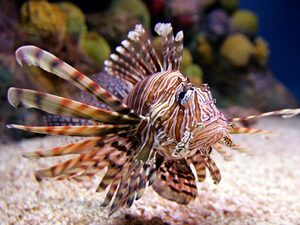
The spiny, venomous lionfish can kill three-quarters of a reef's fish population in just five weeks, according to one study. Michael Dwyer/AP

The spiny, venomous lionfish can kill three-quarters of a reef's fish population in just five weeks, according to one study.Michael Dwyer/AP
In 1992, Hurricane Andrew smashed an aquarium tank in Florida. About a half-dozen spiny, venomous lionfish washed into the Atlantic Ocean, spawning an invasion that could kill off local industry along with the native fish.
People come to the Exuma Islands in the Bahamas to kayak between tiny, uninhabited islands and dive in the shallow, turquoise water. Above the water, the landscape looks like a pristine tropical paradise. But the same isn't true beneath the waves.
"In 2005, the first lionfish showed up, and we didn't pay much attention to it," says Oregon State University zoology professor Mark Hixon, who has studied reef fish here for almost two decades. "The next year, we saw a few more. Then in 2007 there was a population explosion. There were so many lionfish around that they were eating the fish we were studying, and we had to start studying the lionfish. There was nothing else to do."
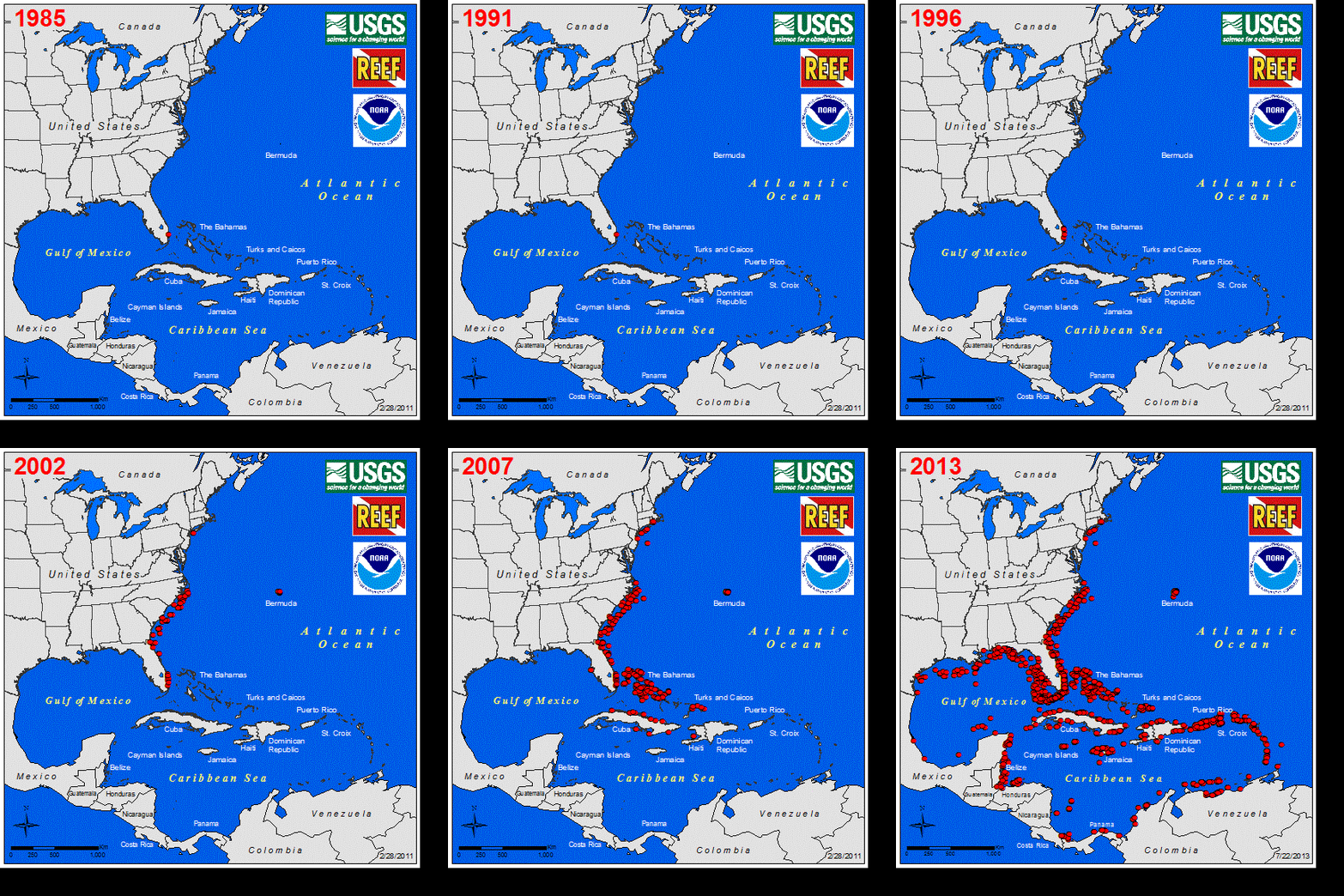
Lionfish are native to the Indian and Pacific oceans. But in the past few years, they've spread up the Eastern seaboard and throughout the Caribbean. The Bahamas have been hit the hardest.
At NOAA.gov
They're hard to miss with their red and white stripes and a tall row of venomous spines down their backs. The fan-like fins look like a lion's mane. And like lions, they are ferocious predators. Last year, Hixon co-authored a study with Mark Albins that showed a lionfish can kill three-quarters of a reef's fish population in just five weeks.
"This year we're going to see if that's gotten worse — because the number of lionfish has definitely increased in the intervening year," Hixon says.
What Stops A Lionfish?
Diving around a coral reef, Hixon shines a light under every ledge, looking for lionfish and the fish they like to eat. After a few minutes, he waves his light frantically under an overhang. A lionfish the size of a football fans the water with its huge, quilled fins. These days, the only thing unusual about spotting a lionfish in the Bahamas is seeing just one of them.
Back on the boat, Hixon is upbeat. Last year his team pulled more than a dozen lionfish off this reef. "And this year, there's just one," he says. "What that tells us is that our removals took, and lasted a whole year."
But Hixon says divers can only catch so many. So he's also studying native lionfish in the Pacific Ocean to understand what keeps their populations in check.
Parasites could be one limiting factor. Zoologist Paul Sikkel peers through a microscope at the gills of one of the lionfish Hixon's team has just caught.
"Wow! Just so clean," Sikkel exclaims. "There's nothing in there. Have a look. A local fish, you'd see a bunch of really small worms on those red gill filaments. And they squirm, so it's easy to pick them out. But there's nothing on there."
The parasites that would be swarming over a local fish aren't going near the lionfish. Sikkel says that might be one secret to the invasion.
"If you consider parasites a sort of a tax that fish have to pay, a lot of their energy gets diverted into parasites, and so a fish that doesn't have those [parasites] can develop more of its energy into its own growth and reproduction," Sikkel says.
Tourism, Fishing Fall Prey
Until marine predators or parasites learn to feed on lionfish, the best hope for slowing the spread may be humans. The fish are a delicacy in Asia, but not in the Bahamas, given the painful sting their spines can inflict. A few restaurants serve lionfish now, and there's an effort to teach Bahamians how to catch and cook them.
From The USGS
Lakeshia Anderson with the Bahamas Department of Fisheries says the livelihoods of many islanders depend on slowing the invasion.
"With the quantities of lionfish that we've found in our waters and the amount of food they consume, it has the potential of really collapsing our commercially important species — our fishing industry in general," Anderson says.
But that's not all. Tourism is a $5 billion-a-year industry and accounts for half the employment in the Bahamas. Anderson worries that if the lionfish continue to devour colorful reef fish, divers will vacation elsewhere.
Hixon says in some places, the damage is already done.
"I was diving on a reef I've studied since 1991," he recounts. "It was so degraded, and there were so few fish in what used to be a teeming reef, that at one point I was overcome and went to tears."
He says in the best case scenario, some natural control will kick in and lionfish will become a minor part of the Caribbean and Atlantic reef community.
Flying frog among 353 new Himalayan species: WWF
A flying frog, the world's smallest deer and the first new monkey to be found in over a century are among 350 new species discovered in the eastern Himalayas in the past decade, the WWF said Monday.
But the environmental group said the vital habitats of the mountain range were facing growing pressures from unsustainable development in the region, which spans Nepal, China, India, Bhutan and Myanmar.
In a report released here, it said climate change, deforestation, overgrazing by domestic livestock and illegal poaching and wildlife trading threatened one of the biologically richest areas of the planet.
"In the last half-century, this area of South Asia has faced a wave of pressures as a result of population growth and the increasing demand for commodities," said the report, "The Eastern Himalayas -- Where Worlds Collide."
"Only 25 percent of the original habitats in the region remain intact. For the unique species of the Eastern Himalayas, this means that today 163 are considered globally threatened," it said.
The WWF said 353 new species were discovered in the region between 1998 and 2008, among them a red-footed tree frog known as a "flying frog" because its large webbed feet allow it to glide when falling.
Another new species was a kind of caecilian, a limbless amphibian that resembles a giant earthworm and lives underground -- a significant discovery because caecilians are among the planet's least-studied creatures.
Other highlights were the world's smallest deer -- a miniature muntjac standing just 60-80 centimetres (25-30 inches) tall that was found in northern Myanmar -- and the first new monkey species to be discovered in over a century.
The WWF said the new species of macaque was one of the highest-dwelling monkeys in the world, living in India's Arunachal Pradesh state at between 1,600 and 3,500 metres (5,000 and 11,500 feet) above sea level.
Among the 242 new plant varieties discovered was an ultramarine blue flower found by two intrepid Chinese botanists who descended into a gorge in Tibet that is twice as deep as the Grand Canyon in places.
The WWF described the rare bloom as "dramatic in both colour and form" and said its colour changed with the temperature, making it particularly remarkable.
The eastern Himalayas is home to 10,000 plant species, 300 mammal species and nearly 1,000 bird species, and is the last place on earth where the greater one-horned rhino can still be found.
"This enormous cultural and biological diversity underscores the fragile nature of an environment which risks being lost forever unless the impacts of climate change are reversed," said Tariq Aziz, leader of the WWF's Living Himalayas initiative.
The report's findings come as world leaders prepare to gather in Copenhagen in December to reach agreement on a new climate deal to replace the Kyoto Protocol.


Sunday, August 9, 2009
Boulder & 'Julia': Can Boulder channel its inner Julia Child -- while being locavore and vegan?
When Julie Powell decided to cook her way through Julia Child's "Mastering the Art of French Cooking," she found her passion and changed her life.
How would Boulder's notoriously particular eaters -- many of whom view food through a environmental, health and political lens -- interpret one of Child's classic recipes, the bacon, cream and egg tart, Quiche Lorraine?
At Culinary School of the Rockies, appreciation for Julia Child's role in modern American cooking is a given. Office staffers are trying out Child's recipes and blogging about them a la Julie, and the school is offering a home cooking class -- nearly full at the time of this writing -- on Aug. 15 called "Brunch and Julia."
Chef Adam Dulye says American cooks have come back to essence of Child's approach -- sourcing impeccably fresh local ingredients and combining them in straightforward, flavorful ways.
"I think it's definitely back to simple is the way to go," he says. "Only three or four items on a plate. This is a pork chop (that) tastes like a pork chop."
Not the multi-ingredient, layers of exotic ingredients that were popular in the 1980s and 1990s.
Of Child's cooking, he says: "It's going to the market and cooking it. In Boulder, we have a great opportunity to do (Quiche Lorraine) from the ground up. There are people who mill flour, fresh eggs, a couple of dairies, John Long pork. Haystack puts out a firm goat cheese. Dulye might throw in a few of the last spring onions.
While Quiche Lorraine is likely to please locavores, for vegans it's pretty tough sledding. Matt Burns sous chef at Leaf Vegetarian Restaurant says the staff does make eggless egg dishes, but that quiche would be particularly challenging.
He says a custard might be approximated using tofu, soy milk and ground flax seed to help thicken it. Soy cheese and a soy bacon product completes the not-exactly appetizing picture.
"That's why we don't do it here," he says of making quiche at Leaf.
The one bright spot would be the crust, which can be made authentically with shortening, flour, salt and water.
The crust is the ingredient in Quiche Lorraine that causes consternation for Celiacs and others who eat gluten free. One option is to go crustless -- but that would be a timbale rather than a quiche. Another option is to make a crust of grated potatoes. Or you can try a pie crust created by local cookbook author Elana Amsterdam, who has just released her book, "The Gluten-Free Almond Flour Cookbook." As you might surmise from the cookbook's name, she would use almond flour -- she prefers blanched almond flour -- to make a crust, which she says is delicious and healthful.
Perhaps the best approach is not to attempt to recreate the substance of Child's cooking, but rather its spirit -- using high quality ingredients in a way that shows off their essence. Thus, better not for a vegan to try to make a quiche, whose defining quality is the happy marriage of egg and cream. For gluten free eaters, anything approaching French pastry is probably out of the question, although an almond crust is made from a food Child would recognize as opposed to, say, xanthan gum.
Above all, Dulye says, Child would want people to spend some time and care cooking whatever their beliefs or health require.
"To some degree, Julia would sit back and have a good laugh at some of the stuff we do in our kitchens," he says, listing the purchase of pre-made pie crust as an example. "She would say, 'Oh, they'll learn. They'll come around."
Subscribe to:
Posts (Atom)