Ten years ago while working in Laikipia, Hassan Sachedina met Peter Ragg who was flying for the Laikipia Predator Project. After Laikipia, Peter piloted his Cessna 182 to Gabon and worked for Wildlife Conservation Society for some years before joining well-known WCS scientist, Dr. Mike Fay on the 'MegaFlyOver'. The MegaFlyOver was an ambitious project to fly across Africa photographing the wildest areas from the air every 10 or so seconds. At a presentation in Arusha in the mid 2000's, Mike Fay, in shorts and Teva sandals, explained to an assembled crowd at the Arusha Hotel the technology and thinking behind the FlyOver. It had grown out of Fay's well-known 'Mega-Transect' where his adventurous walk across Central Africa's densest forests was documented by National Geographic. The Mega-Transect ended up in Gabon where Fay's lobbying efforts helped to create 13 National Parks - 10% of Gabon's surface area- in one fell swoop.
All photos credit: Peter Ragg
Building the MegaFlyOver experiences, Peter and his associates formed Conservation Air Patrol to provide cutting edge technology and multi-media data from an aerial platform to support decision making. Peter and I reconnected in 2006 to discuss collaboration on Conservation Air Patrol (CAP). CAP takes wildlife and resource surveys to the next level and now operates a fleet of survey modified C-182's (and soon twin engine aircraft) strategically deployed around Africa. CAP's distinctly red-painted aircraft are equipped with 14 megapixel digital frame cameras that produce ground resolutions between 10 and 80 centimeters. In other words, these platforms produce higher resolution images than high-resolution satellite imagery, delivered in less time and cheaper than sat imagery.
Sunday, March 14, 2010


Saturday, February 27, 2010
MASSIVE EARTHQUAKE IN CHILIE

CNN 

More than 2 million affected by earthquake, Chile's president says
February 28, 2010 -- Updated 0042 GMT (0842 HKT)


Chilean port heavily damaged
STORY HIGHLIGHTS
- NEW: More than 2 million affected by quake, Chile's president says
- At least least 214 people were killed in the quake and the resulting tsunami
- President Michelle Bachelet: Town of Chillan was one of the worst affected
- Larry King discusses the disaster on Larry King Live" Saturday at 9 p.m. ET
At least least 214 people were killed in the quake and the resulting tsunami, which ravaged parts of the Chilean coast and fanned out across the Pacific Ocean.
A large wave killed three people and 10 were missing on the island of Juan Fernandez, 400 miles (643 km) off the coast of Chile, said Provincial Governor Ivan De La Maza.
On mainland Chile, the task of trying to save survivors and recover the dead was fully under way. Buildings lay in rubble, bridges and highway overpasses were toppled and roads buckled like rumpled paper. Mangled cars were strewn on several highways, many of the vehicles coming to rest on their roofs.
iReport.com: Did you feel it? Share information, images with CNN
"This is a major event. This happened near some very populated areas," said Randy Baldwin, a geophysicist with the U.S. Geological Survey. "With an 8.8 you expect damage to the population in the area."
As the day unfolded, desperate relatives searched for missing loved ones. Many of the survivors took to the Internet to ask for help in locating relatives.

 Video: 'Let's be strong, Chile'
  Video: 'Absolutely terrifying'
  Video: 'U.S. stands ready to assist'
 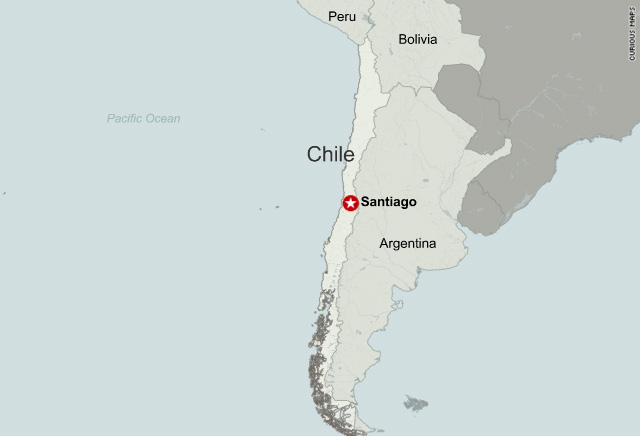 Earthquake locator map
 RELATED TOPICS
The quake struck at 3:34 a.m. (1:34 a.m. ET) off the Pacific coast at a depth of nearly 22 miles (35 km) and about 60 miles (100 km) northwest of Chillan, Chile, the USGS said. Santiago, the capital, is 200 miles (325 km) northeast of the epicenter.
At least 33 aftershocks were reported, including a 6.3-magnitude in Argentina.
"There are really aftershocks like every hour," said Felipe Baytelman, speaking to CNN from Santiago.
Chilean officials took to the airwaves to try to control any jitters.
"We are asking everyone to stay calm, to be patient," Chilean President Michelle Bachelet told reporters after inspecting some of the damaged areas. "We assure everyone that emergency crews are working to resolve these issues."
Bachelet declared areas of catastrophe, similar to a state of emergency, which will allow her to rush in aid. She said the town of Chillan -- which was destroyed by a killer quake in 1939 -- was one of the worst affected.
Check out the world's biggest earthquakes since 1900
Bachelet noted that two of the largest hospitals had suffered structural damage and patients were taken to other facilities. Other public institutions also were affected.
The military was coordinating the transfer of patients to hospitals, said Undersecretary of Public Health Jeanette Vega. "All patients are being cared for," she told reporters in the city of Concepcion.
But she pleaded for anyone who did not need immediate medical care not to seek treatment. "This is a time when we need to be in solidarity with the people who need it most," she said, also asking for any health workers able to pitch in to do so.
Four field hospitals were being set up and tanker trucks full of fresh water were already circulating in areas that had lost access to clean water, she said.
Other public institutions also were affected. "There were reports of riots at one of the jails," Bachelet said. "The jails have, of course, received significant damage. The justice department is looking into the situation, evaluating the damage. We are looking into possibly moving some of these inmates."
The president also asked Chileans to help each other.
"We are looking into shelters," she said. "We are looking into other people providing room in their homes."
In Washington, Chilean ambassador Jose Goni said Chile could manage the catastrophe.
"Eventually, after deeper examination, the government may decide it needs support in some areas," he told CNN.
The United States has resources positioned to assist if Chile requests help, President Obama said in a midafternoon address to the nation.
Obama also warned residents in Hawaii and other areas that could be affected by a tsunami to heed safety instructions from state and local officials.
A tsunami warning for Hawaii was lifted Saturday afternoon. Waves of 3 feet were recorded at the city of Hilo on the Big Island of Hawaii, but were lower than expected, and no damage was reported.
Meanwhile, tsunami activity was reported on the island of Tasmania, according to officials in Australia.
Saturday's temblor comes about six weeks after an 7.0-magnitude earthquake devastated parts of Haiti and killed more than 220,000 people. The Chilean quake, at magnitude 8.8, was 700 to 800 times stronger.
Coastal Chile has a history of deadly earthquakes, with 13 quakes of magnitude 7.0 or higher since 1973, the USGS said. As a result, experts noted that newer buildings are constructed to help withstand the shocks.
President-elect Sebastian Pinera, who will take office in March, also was monitoring the situation and warned, "The number of victims could get higher."
The capital lost electricity and basic services, including water and telephones. Bachelet said regional hospitals had suffered damage; some were evacuated. A major bridge connecting northern and southern Chile was rendered inoperable, and the Santiago airport was shut down for at least the next 24 hours.
Chilean television showed buildings in tatters in Concepcion, in coastal central Chile. Whole sides of buildings were torn off, and at least two structures were engulfed in flames. Video showed roads that were destroyed and impassable.
The earth's rumbling was felt by millions in Chile and in parts of Argentina as well. Some buildings were evacuated in the Argentine capital, Buenos Aires, which is 690 miles (1,111 kilometers) away from Santiago.
In Hawaii, the U.S. Coast Guard closed all commercial ports in the Hawaiian islands to incoming traffic and was encouraging vessels to evacuate to sea. All recreational boaters were asked to take immediate precautions and avoid the water.
In addition, four of 10 U.S. military ships in port in Hawaii were heading out to sea. One ship in San Diego got under way because of high seas.
California and Alaska were under a tsunami advisory.
Follow tsunami warning information
But evacuations of coastal areas began at 6 a.m. (11 a.m. ET). Outdoor siren systems in each Hawaiian county sounded simultaneously to alert residents and visitors to evacuate coastal areas, and U.S. Air Force planes equipped with loudspeakers flew over more remote areas to issue warnings.
CNN Chile, CNN's partner network, suffered damage to its broadcast facilities but continued operating.
Eduardo de Canto, the head of airport operations in Santiago, told Chile's TVN that the terminal in the airport is severely damaged although he said runways were operational.
Santiago resident Leo Perioto jumped out of his bed in his apartment at the top of a six-story building.
"The whole building was shaking," he said. "The windows were wobbling a lot. We could feel the walls moving from side to side."
Glass shattered at the Santiago Marriott Hotel, but there appeared to be no structural damage, said Alessandro Perez.
Anita Herrera at the Hotel Kennedy in Santiago said electricity was out and guests were nervous.
"Our hotel is built for this," she said. "In Chile, this happens many times."
The U.S. State Department said all but two U.S. Embassy personnel in Chile were accounted for.
Secretary of State Hillary Clinton said she will proceed Sunday with her planned trip to five Latin American countries, including Chile.
Saturday's epicenter was just a few miles north of the largest earthquake recorded in the world: a magnitude 9.5 quake in May 1960 that killed 1,655 and unleashed a tsunami that crossed the Pacific.
CNN's Rolando Santos, Brian Byrnes and Patty Lane contributed to this report.

Tuesday, February 16, 2010
Weather model shows where California will burn
THIS year, southern California will burn - you can count on it. But we may now be able to predict which areas will be worst hit, thanks to this map. It was compiled by Max Moritz's team at the University of California, Berkeley, and is the first to take into account fire-friendly weather.
Wild fires cause millions of dollars of damage each year in California and elsewhere. Fire researchers typically identify risk areas by looking for flammable vegetation and features like canyons that can funnel fires. There is a third factor, however, that stokes many of the worst infernos: hot, dry winds, like the Santa Ana winds of southern California and the sirocco around the Mediterranean.
Moritz and his colleagues used a computer model of fine-scale weather patterns to predict temperature, wind speed and humidity at 6-kilometre intervals across southern California during Santa Ana wind events, then calculated the fire risk at each point. When they compared their map with historical fire records, the researchers found that the areas they had identified as being at high and low risk were equally as likely to burn, but the impact of fire was greatest in a high-risk area (Geophysical Review Letters, DOI: 10.1029/2009GL041735, in press).
Moritz's map may help planners guide housing development away from the riskiest areas. The approach could also be used in other fire-prone regions like South Africa and western Australia, he says.
GM seeking more U.S. ethanol fueling stations
General Motors Co's growing output of vehicles capable of running on ethanol-gasoline blends won't help cut polluting emissions or U.S. dependence on foreign oil until a slim network of stations dispensing ethanol is greatly expanded, GM Vice Chairman Tom Stevens said.
Half of GM's vehicle lineup will be able to run on a mix of 15 percent gasoline and 85 percent ethanol, called E85, by the 2012 model year, said Stevens, GM's vice chairman for global product operations.
"GM is spending about $100 million a year adding flex-fuel capability to our vehicles. We can't afford to leave this capital stranded," Stevens is to tell attendees in a speech on Tuesday at the Renewable Fuels Association conference.
A copy of the speech was provided to reporters on Monday.
Adding the capability to run on E85 costs adds as much as $70 to the production cost of each vehicle, Stevens said.
GM has produced 4 million of the 7.5 million flex-fuel vehicles on U.S. roads now, said Coleman Jones, GM biofuel implementation manager.
Stevens said GM has worked with the National Governor's Association and ethanol producers and dispensers to add 350 more ethanol-blend pumps in the United States. He said GM would welcome federal government assistance to finance expansion of that network, but he offered no specifics on how that would work.
"Today's there's 2,200 (ethanol fuel stations) that are out there but that's not enough," said Stevens.
"Two-thirds of the pumps are concentrated in 10 states and those 10 states have only about 19 percent of the flex-fuel vehicles that we have on the road," said Stevens. "That's a big problem for us."
Those 10 states are all in the U.S. Midwest, heart of corn production in the United States. Corn is the dominant source of U.S.-produced ethanol.
Stevens said there are about 160,000 U.S. gasoline stations, and there need to be 12,000 or more ethanol stations "to have ethanol fuel available for every one of our customers within about two miles of where they live. So, we've got some work to do there to get the additional 10,000 pumps in." Ethanol-gasoline blends emit less polluting carbon dioxide than conventional gasoline, and is mainly produced domestically.
Energy legislation passed by the U.S. Congress in 2007 set binding targets for fuel blending each year. Ethanol use is to rise to about 20.5 billion gallons by 2015 and 35 billion gallons by 2022 from 4 billion gallons in 2006 and almost 13 billion gallons in 2009.
One gallon of liquid equals a liter.
The U.S. Environmental Protection Agency has said that ethanol-gasoline blends must increase the ethanol portion to much higher than the current limit of 10 percent, and increase use of other sources of ethanol than corn, such as switchgrass and landfill and farm waste.
Half of GM's vehicle lineup will be able to run on a mix of 15 percent gasoline and 85 percent ethanol, called E85, by the 2012 model year, said Stevens, GM's vice chairman for global product operations.
"GM is spending about $100 million a year adding flex-fuel capability to our vehicles. We can't afford to leave this capital stranded," Stevens is to tell attendees in a speech on Tuesday at the Renewable Fuels Association conference.
A copy of the speech was provided to reporters on Monday.
Adding the capability to run on E85 costs adds as much as $70 to the production cost of each vehicle, Stevens said.
GM has produced 4 million of the 7.5 million flex-fuel vehicles on U.S. roads now, said Coleman Jones, GM biofuel implementation manager.
Stevens said GM has worked with the National Governor's Association and ethanol producers and dispensers to add 350 more ethanol-blend pumps in the United States. He said GM would welcome federal government assistance to finance expansion of that network, but he offered no specifics on how that would work.
"Today's there's 2,200 (ethanol fuel stations) that are out there but that's not enough," said Stevens.
"Two-thirds of the pumps are concentrated in 10 states and those 10 states have only about 19 percent of the flex-fuel vehicles that we have on the road," said Stevens. "That's a big problem for us."
Those 10 states are all in the U.S. Midwest, heart of corn production in the United States. Corn is the dominant source of U.S.-produced ethanol.
Stevens said there are about 160,000 U.S. gasoline stations, and there need to be 12,000 or more ethanol stations "to have ethanol fuel available for every one of our customers within about two miles of where they live. So, we've got some work to do there to get the additional 10,000 pumps in." Ethanol-gasoline blends emit less polluting carbon dioxide than conventional gasoline, and is mainly produced domestically.
Energy legislation passed by the U.S. Congress in 2007 set binding targets for fuel blending each year. Ethanol use is to rise to about 20.5 billion gallons by 2015 and 35 billion gallons by 2022 from 4 billion gallons in 2006 and almost 13 billion gallons in 2009.
One gallon of liquid equals a liter.
The U.S. Environmental Protection Agency has said that ethanol-gasoline blends must increase the ethanol portion to much higher than the current limit of 10 percent, and increase use of other sources of ethanol than corn, such as switchgrass and landfill and farm waste.
Sunday, February 14, 2010
World may not be warming, say scientists
The United Nations climate panel faces a new challenge with scientists casting doubt on its claim that global temperatures are rising inexorably because of human pollution.
In its last assessment the Intergovernmental Panel on Climate Change (IPCC) said the evidence that the world was warming was “unequivocal”.
It warned that greenhouse gases had already heated the world by 0.7C and that there could be 5C-6C more warming by 2100, with devastating impacts on humanity and wildlife. However, new research, including work by British scientists, is casting doubt on such claims. Some even suggest the world may not be warming much at all.
“The temperature records cannot be relied on as indicators of global change,” said John Christy, professor of atmospheric science at the University of Alabama in Huntsville, a The doubts of Christy and a number of other researchers focus on the thousands of weather stations around the world, which have been used to collect temperature data over the past 150 years.
These stations, they believe, have been seriously compromised by factors such as urbanisation, changes in land use and, in many cases, being moved from site to site.
Christy has published research papers looking at these effects in three different regions: east Africa, and the American states of California and Alabama.
“The story is the same for each one,” he said. “The popular data sets show a lot of warming but the apparent temperature rise was actually caused by local factors affecting the weather stations, such as land development.”
The IPCC faces similar criticisms from Ross McKitrick, professor of economics at the University of Guelph, Canada, who was invited by the panel to review its last report.
The experience turned him into a strong critic and he has since published a research paper questioning its methods.
“We concluded, with overwhelming statistical significance, that the IPCC’s climate data are contaminated with surface effects from industrialisation and data quality problems. These add up to a large warming bias,” he said.
Such warnings are supported by a study of US weather stations co-written by Anthony Watts, an American meteorologist and climate change sceptic.
His study, which has not been peer reviewed, is illustrated with photographs of weather stations in locations where their readings are distorted by heat-generating equipment.
Some are next to air- conditioning units or are on waste treatment plants. One of the most infamous shows a weather station next to a waste incinerator.
Watts has also found examples overseas, such as the weather station at Rome airport, which catches the hot exhaust fumes emitted by taxiing jets.
In Britain, a weather station at Manchester airport was built when the surrounding land was mainly fields but is now surrounded by heat-generating buildings.
Terry Mills, professor of applied statistics and econometrics at Loughborough University, looked at the same data as the IPCC. He found that the warming trend it reported over the past 30 years or so was just as likely to be due to random fluctuations as to the impacts of greenhouse gases. Mills’s findings are to be published in Climatic Change, an environmental journal.
“The earth has gone through warming spells like these at least twice before in the last 1,000 years,” he said.
Kevin Trenberth, a lead author of the chapter of the IPCC report that deals with the observed temperature changes, said he accepted there were problems with the global thermometer record but these had been accounted for in the final report.
“It’s not just temperature rises that tell us the world is warming,” he said. “We also have physical changes like the fact that sea levels have risen around five inches since 1972, the Arctic icecap has declined by 40% and snow cover in the northern hemisphere has declined.”
The European Centre for Medium-Range Weather Forecasts has recently issued a new set of global temperature readings covering the past 30 years, with thermometer readings augmented by satellite data.
Dr Vicky Pope, head of climate change advice at the Met Office, said: “This new set of data confirms the trend towards rising global temperatures and suggest that, if anything, the world is warming even more quickly than we had thought.”
In its last assessment the Intergovernmental Panel on Climate Change (IPCC) said the evidence that the world was warming was “unequivocal”.
It warned that greenhouse gases had already heated the world by 0.7C and that there could be 5C-6C more warming by 2100, with devastating impacts on humanity and wildlife. However, new research, including work by British scientists, is casting doubt on such claims. Some even suggest the world may not be warming much at all.
“The temperature records cannot be relied on as indicators of global change,” said John Christy, professor of atmospheric science at the University of Alabama in Huntsville, a The doubts of Christy and a number of other researchers focus on the thousands of weather stations around the world, which have been used to collect temperature data over the past 150 years.
These stations, they believe, have been seriously compromised by factors such as urbanisation, changes in land use and, in many cases, being moved from site to site.
Christy has published research papers looking at these effects in three different regions: east Africa, and the American states of California and Alabama.
“The story is the same for each one,” he said. “The popular data sets show a lot of warming but the apparent temperature rise was actually caused by local factors affecting the weather stations, such as land development.”
The IPCC faces similar criticisms from Ross McKitrick, professor of economics at the University of Guelph, Canada, who was invited by the panel to review its last report.
The experience turned him into a strong critic and he has since published a research paper questioning its methods.
“We concluded, with overwhelming statistical significance, that the IPCC’s climate data are contaminated with surface effects from industrialisation and data quality problems. These add up to a large warming bias,” he said.
Such warnings are supported by a study of US weather stations co-written by Anthony Watts, an American meteorologist and climate change sceptic.
His study, which has not been peer reviewed, is illustrated with photographs of weather stations in locations where their readings are distorted by heat-generating equipment.
Some are next to air- conditioning units or are on waste treatment plants. One of the most infamous shows a weather station next to a waste incinerator.
Watts has also found examples overseas, such as the weather station at Rome airport, which catches the hot exhaust fumes emitted by taxiing jets.
In Britain, a weather station at Manchester airport was built when the surrounding land was mainly fields but is now surrounded by heat-generating buildings.
Terry Mills, professor of applied statistics and econometrics at Loughborough University, looked at the same data as the IPCC. He found that the warming trend it reported over the past 30 years or so was just as likely to be due to random fluctuations as to the impacts of greenhouse gases. Mills’s findings are to be published in Climatic Change, an environmental journal.
“The earth has gone through warming spells like these at least twice before in the last 1,000 years,” he said.
Kevin Trenberth, a lead author of the chapter of the IPCC report that deals with the observed temperature changes, said he accepted there were problems with the global thermometer record but these had been accounted for in the final report.
“It’s not just temperature rises that tell us the world is warming,” he said. “We also have physical changes like the fact that sea levels have risen around five inches since 1972, the Arctic icecap has declined by 40% and snow cover in the northern hemisphere has declined.”
The European Centre for Medium-Range Weather Forecasts has recently issued a new set of global temperature readings covering the past 30 years, with thermometer readings augmented by satellite data.
Dr Vicky Pope, head of climate change advice at the Met Office, said: “This new set of data confirms the trend towards rising global temperatures and suggest that, if anything, the world is warming even more quickly than we had thought.”
Monday, December 21, 2009
ReusableBags.com Wins Green America’s People’s Choice Award for the Second Time
Last month at the San Francisco Green Festival, ReusableBags.com received Green America’s second-ever Longtime Leadership Award, which honors businesses that take the top spot in the People’s Choice contest more than once.
ReusableBags.com previously won Green America’s People’s Choice Award in 2007. Since launching in 2003, the company has grown to provide hundreds of high-quality reusables in more than 30 categories, has empowered 210,000+ customers to save an astounding 800,000,000 use-and-toss items and has been an important catalyst in the broad reusables movement. ReusableBags.com also serves as an information hub, providing myth-busting articles, news and more on issues related to over-consumption.
“We’ve always been about much more than just bags. Reuseit.com - the new name for our store - accurately reflects our growing family of practical, high-quality reusables for every part of your life,” said Vincent Cobb, founder of ReusableBags.com. “From day one, it’s been our mission to empower people with the best tools to break their addiction to disposables.”
The Green America People’s Choice Award winners were chosen by individual voters across the country. Each year, thousands of consumers nationwide take part in a Green America online questionnaire to select their favorite green businesses, and nominees are then narrowed to the top ten. The public was then invited to vote for their favorite amongst the ten finalists, and fifteen thousand people participated. Reusablebags.com just edged out finalist Care2.com for the most number of votes. Both Care2.com and Lunapads International also took home awards at this year’s event. Past winners include IdealBite and Ten Thousand Villages.
“It is truly exciting to see tens of thousands of environmentally and socially conscious consumers from around the country take part in voting for their favorite green business this year.” said Green America’s Green Business Director, Denise Hamler. “All of this year’s finalists are leaders in creating a green economy and we thank each of them for their leadership in demonstrating that successful businesses can also uphold the highest environmental and social values.”
Green America (http://www.GreenAmericaToday.org) is a non-profit membership organization founded in 1982 with the mission to harness economic power—the strength of consumers, investors, businesses, and the marketplace—and to create a socially just and environmentally sustainable society.
About ReusableBags.com
The Reusablebags.com store (soon to be Reuseit.com) is the leading online source for high-quality reusable products and the site provides information on the problems related to over-consumption of use-and-toss items. Recognized as a leader and innovator, the company won the prestigious Green Business of the Year, People's Choice Award in 2007 and is a BizRate Circle of Excellence Gold Honoree. Reusablebags.com/Reuseit.com is an authentic, triple-bottom-line company, supporting Fair Trade Practices and donating one percent of all sales to environmental causes through 1% For the Planet. The site has been featured in hundreds of news stories, including NPR's Marketplace, The New York Times and The Wall Street Journal and was endorsed in An Inconvenient Truth.
ReusableBags.com previously won Green America’s People’s Choice Award in 2007. Since launching in 2003, the company has grown to provide hundreds of high-quality reusables in more than 30 categories, has empowered 210,000+ customers to save an astounding 800,000,000 use-and-toss items and has been an important catalyst in the broad reusables movement. ReusableBags.com also serves as an information hub, providing myth-busting articles, news and more on issues related to over-consumption.
“We’ve always been about much more than just bags. Reuseit.com - the new name for our store - accurately reflects our growing family of practical, high-quality reusables for every part of your life,” said Vincent Cobb, founder of ReusableBags.com. “From day one, it’s been our mission to empower people with the best tools to break their addiction to disposables.”
The Green America People’s Choice Award winners were chosen by individual voters across the country. Each year, thousands of consumers nationwide take part in a Green America online questionnaire to select their favorite green businesses, and nominees are then narrowed to the top ten. The public was then invited to vote for their favorite amongst the ten finalists, and fifteen thousand people participated. Reusablebags.com just edged out finalist Care2.com for the most number of votes. Both Care2.com and Lunapads International also took home awards at this year’s event. Past winners include IdealBite and Ten Thousand Villages.
“It is truly exciting to see tens of thousands of environmentally and socially conscious consumers from around the country take part in voting for their favorite green business this year.” said Green America’s Green Business Director, Denise Hamler. “All of this year’s finalists are leaders in creating a green economy and we thank each of them for their leadership in demonstrating that successful businesses can also uphold the highest environmental and social values.”
Green America (http://www.GreenAmericaToday.org) is a non-profit membership organization founded in 1982 with the mission to harness economic power—the strength of consumers, investors, businesses, and the marketplace—and to create a socially just and environmentally sustainable society.
About ReusableBags.com
The Reusablebags.com store (soon to be Reuseit.com) is the leading online source for high-quality reusable products and the site provides information on the problems related to over-consumption of use-and-toss items. Recognized as a leader and innovator, the company won the prestigious Green Business of the Year, People's Choice Award in 2007 and is a BizRate Circle of Excellence Gold Honoree. Reusablebags.com/Reuseit.com is an authentic, triple-bottom-line company, supporting Fair Trade Practices and donating one percent of all sales to environmental causes through 1% For the Planet. The site has been featured in hundreds of news stories, including NPR's Marketplace, The New York Times and The Wall Street Journal and was endorsed in An Inconvenient Truth.
Sunday, December 13, 2009
Refugees flee drought, war in East Africa

East Africa's 'climate refugees'
Ahead of the global climate talks in December 2009, nine photographers from the photo agency NOOR photographed climate stories from around the world. Their goal: to document some of the causes and consequences, from deforestation to changing sea levels, as well as the people whose lives and jobs are part of the carbon culture.
A woman waits to be processed into Dadaab, the world's largest refugee camp. Located in Kenya 55 miles from the Somali border, the overcrowded camp houses many people fleeing violence in Somalia. Others have fled their homes due to famine and severe drought, a category now being described as "climate refugees."
A woman waits to be processed into Dadaab, the world's largest refugee camp. Located in Kenya 55 miles from the Somali border, the overcrowded camp houses many people fleeing violence in Somalia. Others have fled their homes due to famine and severe drought, a category now being described as "climate refugees."
Subscribe to:
Posts (Atom)